Would you trust Meta's AI agent with your inbox? My take on the Zuckerberg interview
I watched Joanna Stern's Zuckerberg interview on camera. Why trust is the issue Meta can't duck, why an AI that corrects itself isn't a feature, and why Meta gets too little credit for WhatsApp's encryption.
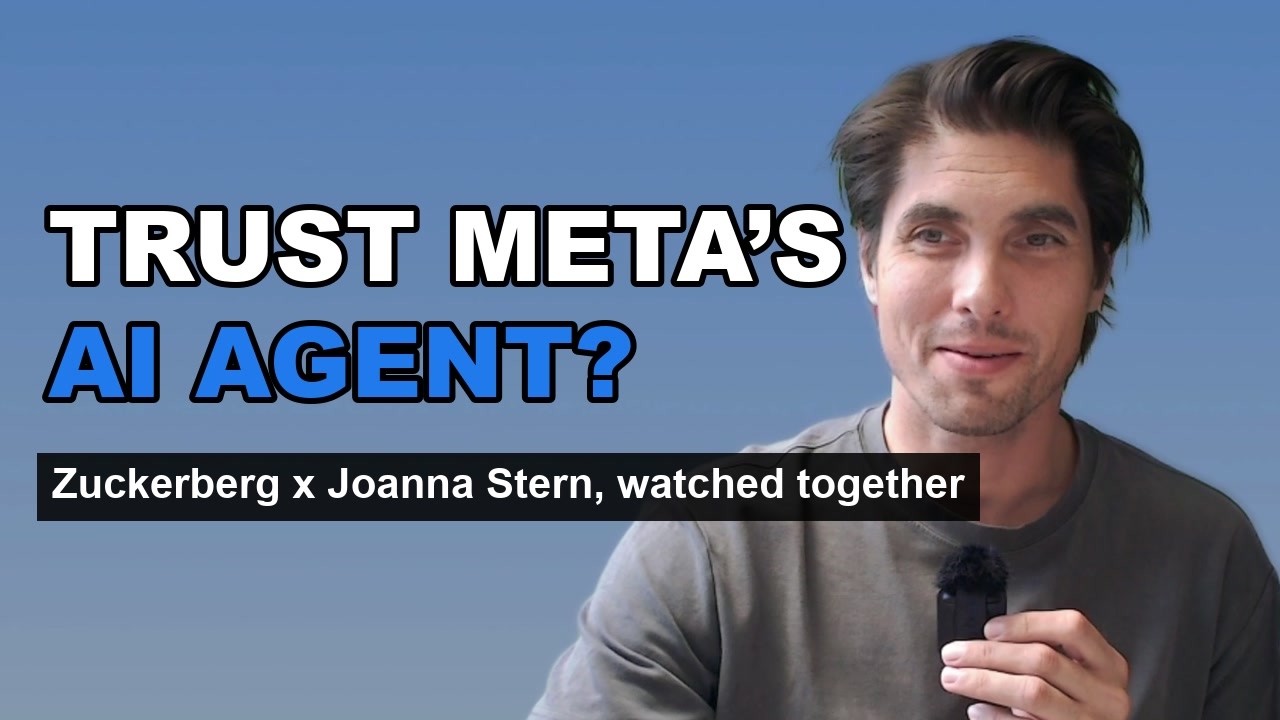
Right after Meta Connect, Joanna Stern sat down with Mark Zuckerberg in Menlo Park and asked him about the new glasses, about Muse, and about the thing hanging over all of it: trust. I hadn't seen the interview yet, so I pressed record, watched it for the first time and paused whenever I had something to say. Which turned out to be quite often.
Here are the moments that stuck with me, and where I land on each.
Trust is the issue Meta can't duck anymore
Zuckerberg opened on responsibility and labs taking their time, before anyone had asked about a product. That tells you something. People are afraid of what AI can do, and rightfully so. For most companies trust is one topic among many. For Meta it is the topic, and every launch now gets read through it.
His answer is that alignment, an AI system doing what you actually tell it to do, is the most important capability right now. More than getting better at math. I agree with the direction. Where I disagree is the implication that we're nearly there.
An AI that keeps correcting itself is not a feature
Joanna mentioned that Muse keeps coming back to her with "you know what, I got something wrong." Zuckerberg called it reflective. I call it a problem. I see the same pattern with Claude's latest models: it keeps revising answers after the fact because it made mistakes the first time. In a chat that's charming. In an agent that books, buys and emails on your behalf, a correction after the fact is a cost that already happened.
As Ethan Mollick puts it in Co-Intelligence: hallucinations are a deep part of how LLMs work.
That's why the operator in the loop still matters. The people who get real leverage out of these tools are the ones who know what the right answer looks like before the agent hands them one. I wrote about that from a different angle when I tested one of my Claude skills against an agent without it: the tool is only as good as the judgement checking it.
The hardware finally looks like something people want
The lineup now runs from Ray-Ban Meta Audio at $349 to a $1,299 pair of VR glasses. The audio glasses have no camera at all, which quietly addresses the privacy worry around filming people without them knowing. And Meta says the hearing enhancement turns them into an FDA-cleared, over-the-counter hearing aid.
That last one is the part I'd underline as a marketer. It is a different target group entirely. We're all getting older, our hearing isn't getting better, and a lot of people skip a hearing aid because it feels bulky or embarrassing. A normal, stylish pair of glasses removes that barrier. It's the same distribution lesson I wrote about with the Muse Charm: put the product where people already are, in a form they already accept.
Muse is Gemini Spark and Claude Cowork for everyone else
Strip away the avatar and Muse does what Gemini Spark and Claude Cowork already do for people who are comfortable with technical tools. It gets access to your computer, your accounts, your email and your messages, and you give it a goal instead of a task. The difference is that Meta made it less codey and more consumer-friendly, and it went straight to the top of the App Store. I can absolutely see the appeal.
Zuckerberg's own examples were telling. Find the subscriptions I'm not using and cancel them. Get us a hiking permit. Watch me spar and send feedback between rounds. Give it the goal, and it goes and works on it. That's the endpoint we all want to reach. It's also exactly why the trust question matters so much more for an agent than for a chatbot. We already saw where the friction starts when Amazon blocked Muse from shopping on its site.
Would you give it your Gmail?
Joanna hasn't connected her personal Gmail. She doesn't fully trust Meta with it, and she worries Muse might email people on her behalf in ways she didn't intend. Fair. My take is more pragmatic: if you don't want to share it, don't use it. If you have something to hide, also don't use it. But if you don't, the realistic worst case today is being offered a product at a good discount. We already hand this data to dozens of platforms.
Meta's answer is architecture. According to Zuckerberg, Muse runs in a confidential virtual machine that even Meta can't look into, with a separate sentinel agent that polices what goes in and out and asks you to confirm sensitive actions. He brought in Moxie Marlinspike, who helped build the encryption behind WhatsApp.
And here I think Meta gets too little credit. WhatsApp has had end-to-end encryption for everyone by default since 2016, across billions of users. That doesn't make every Meta product safe. It does mean the company has done this at scale before.
AI and kids: time back, not time away
Joanna's biggest fear is kids growing up talking to an AI companion that agrees with them on everything. It's a real risk, and I'd add a marketing observation: a friendly little device like the Muse puck is destined to be used by kids, and engaging your future customers early is never an accident.
But Zuckerberg's baking example matched my own experience. Over the last twelve months, agents have taken over reports, finances and online orders for me. I catch myself opening certain tools less and less because the work simply runs. That time went back to my family. The same logic sits behind how a fractional executive works with a lean stack: less admin, more judgement.
Where I land
Zuckerberg seems well aware of the current limits. It isn't done, not everything works the way it should, and the pace is still incredible. Meta finally has hardware people actually use and an agent that hit number one. If people come to trust these tools enough to say "find me the cheapest way from A to B, book it and send me the receipt," that changes how we live with technology.
Trust is the product now. The rest is features.
Sources & further reading
External
- Joanna Stern: Mark Zuckerberg on Muse, New Audio-Only Glasses and Killer AI (the original interview)
- Meta: Everything we announced at Meta Connect 2026
- Meta: Your personal agent coming to AI glasses
- Engadget: Everything announced at Meta Connect 2026
- The Next Web: Zuckerberg's Muse pitch and the confidential VM
- Signal: WhatsApp's Signal Protocol integration is now complete
- Ethan Mollick, Co-Intelligence
Related posts