 Remco Livain
I already use most of them every day, and they’ve changed how I work faster than I expected. This week Anthropic added Whiteboards and Sheets in beta and turned Dashboards into Claude Data, which makes seven artifact types in total. Six of them I’d recommend. One I wouldn’t.
What a Claude artifact is
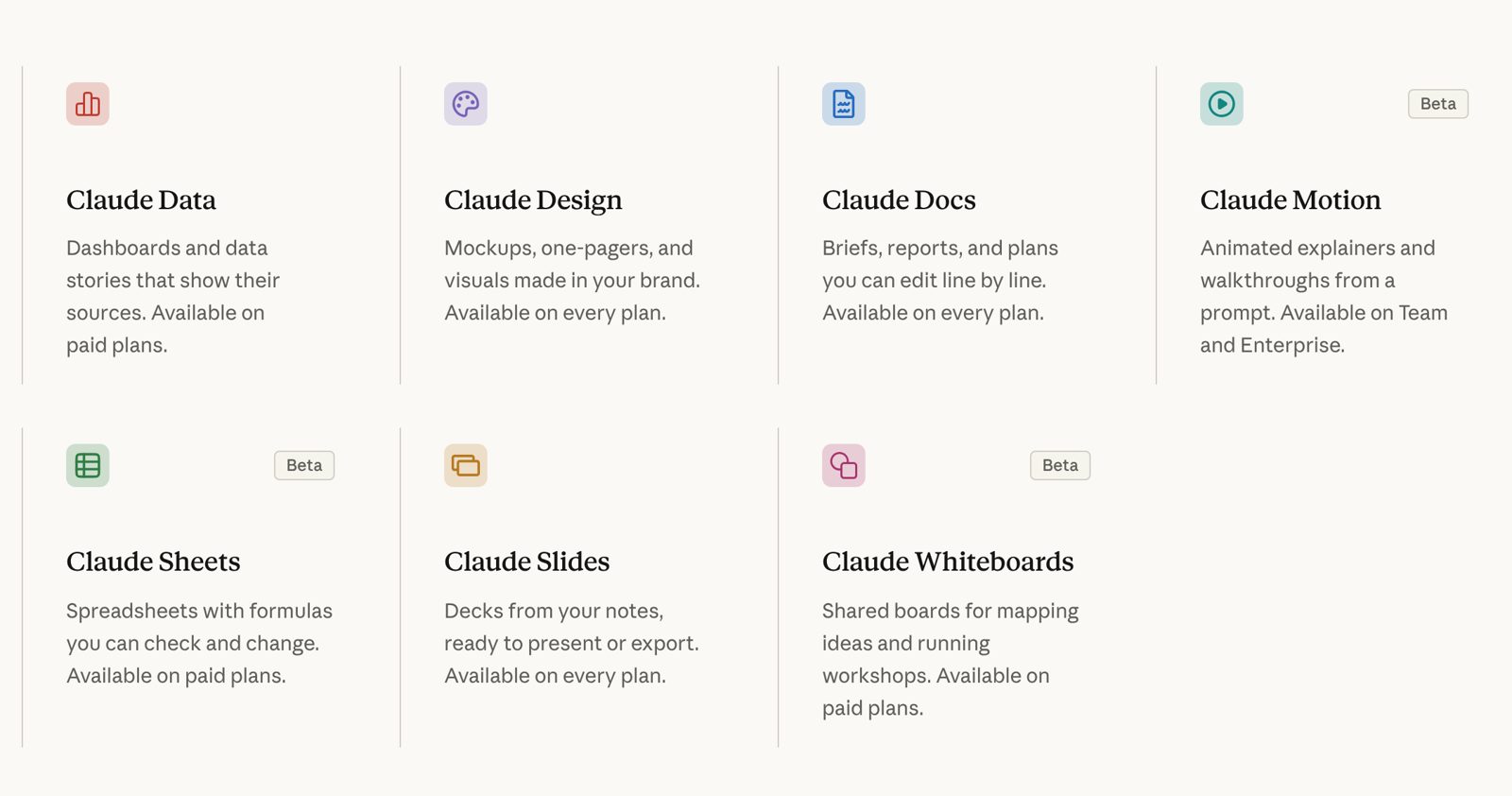
An artifact is anything Claude makes for you that opens beside the conversation: a document, a deck, a spreadsheet, a board, a dashboard, a design or an animation. You can edit it yourself, leave Claude a comment, come back to it later and share it with a link. It’s private until you share it.
Here’s the current line-up, from Anthropic’s artifacts page:
Claude Docs for briefs, reports and plans you edit line by line. Every plan, Free included.
Claude Slides for decks from your notes, ready to present or export to PowerPoint, Google Slides or PDF. Every plan.
Claude Design for mockups, one-pagers and visuals in your brand. Every plan.
Claude Data for dashboards and data stories that show their sources. Paid plans.
Claude Sheets for spreadsheets with formulas you can check and change. Paid plans, in beta.
Claude Whiteboards for shared boards to map ideas and run workshops. Paid plans, in beta.
Claude Motion for animated explainers and walkthroughs from a prompt. Team and Enterprise, in beta.
On top of that, Claude Code now publishes artifacts too: live pages built from a coding session that update in place, with version history at the same link. And if you still live in Microsoft’s tools, Claude already works inside Excel, Word and PowerPoint.
I build fewer decks and more answers
Since Docs and Slides arrived, I spend far less time building slide decks. I prompt my way to a deck that covers 80% of what I need, then fix the last 20% by hand.
That works because most of the slides I make were never really presentations. They report results. They tell a client what happened, what it means and what comes next. They’re living dashboards with some context and text around them, and that’s exactly what Claude Slides is good at. (Sometimes the right home for a number isn’t a dashboard at all, as I found with an e-ink screen.) The same goes for data, and for designs: a mockup for a one-pager, a visual for a post.
Gamma already went a long way here. It made beautiful decks easy and could turn them into little websites. Claude goes a step further, because it draws on far more information, history and insight than Gamma ever had about my work.
The subscriptions I no longer need
There used to be a long list of small tools I paid for. Canva, Figma, PowerPoint, a Microsoft Office subscription. Most of them are fading out of my week.
I’ve always preferred Pages and Numbers anyway, because they’re part of the Apple ecosystem. But I hardly need them either. What I make is mostly raw data that needs to be visualized in some way, and that can happen somewhere else.
There are still two good reasons to open Word or Pages: importing a file from a third party, or a fixed template you fill in the same way every time. Beyond that, it’s hard to argue for them. Ask Claude for “a letter to my client with my header and footer, updated with the latest information from our website,” and it does it, faster than I would, and I can export a PDF to save, send or print like any Word file.
Claude has become the single workhorse I trust to produce what I need, and to move fast.
The setup is the real work
None of this happens out of the box. My Claude knows a lot before I ask anything, because it reads my “brain”, the notes system where my projects, clients and decisions live. My websites live in GitHub repositories and deploy on Cloudflare, so a change to a page is a sentence away. (This post went live the same way.)
The magic of a language model is that you prompt something and get something back. Using it as your daily tool for everything, where it can’t make mistakes and has to be consistent every time, is different. The learning curve is steeper than most people think, and the setup takes real effort. I wrote about why that expertise is the actual leverage in The Death of Generic AI.
Once you’re set up, and especially with these new artifact types, it gets very hard to beat for a solopreneur or a small team. I haven’t used the Team and Enterprise versions enough to judge how it works in a large organization, so I won’t pretend to.
Why I’m least excited about Whiteboards
I understand the appeal. Not everyone works well with long text, and a board makes things visual. Anthropic’s pitch is that you talk a messy plan through out loud, Claude turns it into a board with owners and dates, and your team groups notes on it together. When you’re done, Claude can turn the board into a doc or deck.
I’ve tried to work with whiteboards on many occasions, with many teams. My experience: almost no one knows how to read them, or reads them well. They’re nice for a random brainstorm. But nine times out of ten I want more context, and I want to go deep on every topic. I’d rather spell it out, write it down or say it, so that the information is saved somewhere and the raw insights can be used later.
So the board is an extra step I don’t need. I’d much rather have a team speak their minds on a topic in voice notes, put all of them into one system, and let Claude summarise what’s happening. That’s how this post started, by the way: a twelve-minute voice recording, not a board.
Maybe I’m wrong. Whiteboards seem to be the launch most people are excited about. They’re the one I’m least excited about.
Where I’d start
If you’re on a free plan, start with Docs and Slides: take the next update you’d normally build in PowerPoint and ask Claude for it instead. If you’re on a paid plan, try Sheets for a simple tracker and Data if you have a connector to your numbers. Then cancel one subscription you no longer open.
The tools are getting better every month. The judgement about what to make, and for whom, is still yours. That part hasn’t changed, and it’s why I design before I build.
Sources & further reading
External
- Claude Artifacts: docs, decks and dashboards, Anthropic
- Introducing Claude Whiteboards, Claude Sheets, and Claude Data, Anthropic, 10 November 2026
- Claude Code now supports artifacts, Anthropic, 18 June 2026
- Claude for Microsoft 365, Anthropic
Related posts
- Claude just merged Chat and Cowork
- I put client KPIs on an e-ink screen instead of a dashboard nobody opens
- Microsoft’s new Copilot looks just like Claude
A question about this, or your own experience with it? Write to me.