A clinic chain was advertising its empty appointment slots: why paid media cannot fix a scheduling problem
A year of public EU ad data showed a clinic group buying media against gaps in its own diary. Empty slots are four different problems wearing one name, and only one of them belongs to marketing.
In a public EU ad archive this week I found something I keep thinking about. A clinic group was running a separate paid ad for each of its locations, and the offer in every one of them was the same: last-minute spots available. Those ads had been live, per city, for about seven months.
Read that again as an operator rather than a marketer. The thing being advertised was not a treatment, a price, or a reason to come. It was a gap in the diary.
I work as a fractional marketing executive, a lot of it in dental and medical aesthetics, and this is one of the most expensive patterns in the sector. A clinic has unused capacity. Unused capacity feels like a marketing problem, because marketing is the department you can buy more of. So the media budget gets pointed at the empty slot, and it works just well enough that nobody asks the harder question.
Empty slots are several different problems sharing one name
A gap today because someone cancelled this morning is an operations problem. A recurring gap because a percentage of patients never show is also an operations problem, and a well-studied one — the aesthetics and outpatient literature is full of reminder, deposit and confirmation mechanics that move no-show rates measurably. A predictably quiet Tuesday afternoon is a templating problem: someone built a session pattern that patients were never going to book in that shape.
Only the fourth version is a demand problem. The diary is emptier than the business needs it to be, across every location, every week. That one you can legitimately spend media budget on.
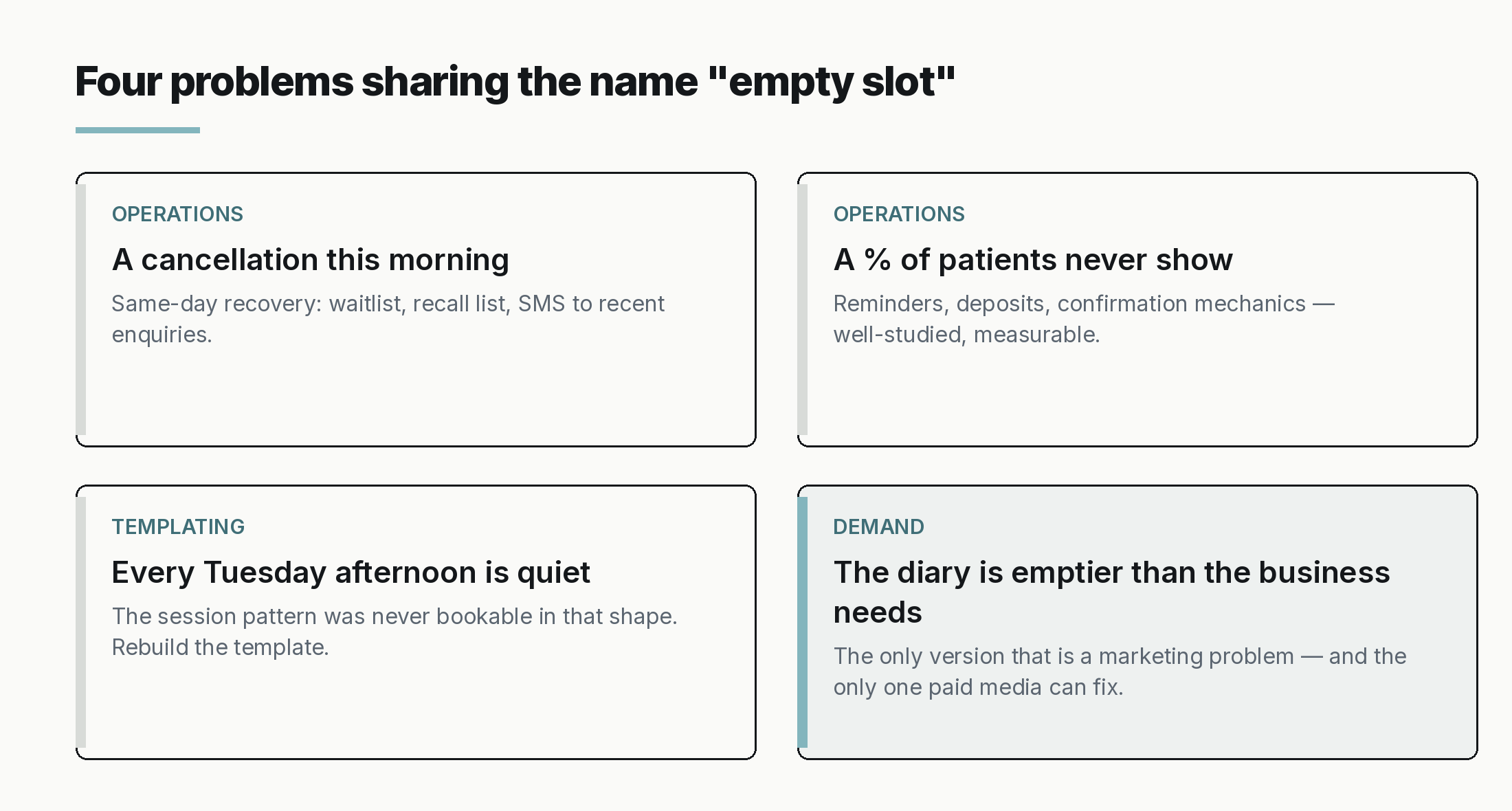
The trouble is that all four look identical on a dashboard. They all show up as utilisation below target, and utilisation below target reads as "we need more patients". Practice-management vendors publish utilisation benchmarks around the 90% mark, and a clinic sitting under that will usually go shopping for reach long before it goes looking at its own booking rules.
If your ads are selling the gap rather than the treatment, you are not buying growth. You are renting away a scheduling problem, every month, at auction prices.
What the spend is actually buying
There is a second cost that doesn't appear in any channel report. An ad that says "we have space today" teaches the market something about you. Run it per location, continuously, for the better part of a year, and you have trained your most price-sensitive patients to wait — because there is always space today, and there is usually something off. I've written before about bolting urgency devices onto offers that have no end date; advertising permanent availability is the same trick pointed the other way, and it erodes the same thing.
The clinics that get out of this don't start with a campaign. They start by splitting the number. How much of this week's unused capacity came from cancellations, how much from no-shows, how much from session templates nobody books, and how much from simply not enough people wanting to come. Four buckets, four owners, four fixes. Usually one of them belongs to marketing and three of them don't.
That decomposition is unglamorous and it is also the entire job. It is the same move as counting patients rather than bookings: refuse to accept an aggregate number as a diagnosis, and insist on knowing which of several different things it is made of. AI tooling makes that decomposition cheap now — I can pull, join and reconcile a year of agenda and transaction data in an afternoon where it used to be a project. What it cannot do is notice that the question was wrong in the first place.
The read-across nobody was doing
One more thing from the same archive, because it matters more than the slot ads. The same group was running visibly different strategies in different countries: a rolling quarterly discount treadmill in one market, monthly city-level specials in another, a lead-form funnel in a third, and in one small market a genuinely interesting pivot to expertise-and-trust messaging — you decide what gets done, not us.
That fourth one is the test the big market needs. Nobody appeared to be reading it. Four markets, four strategies, one year, and no visible mechanism for the good experiment in the small country to reach the large one. I've argued before that somebody has to own the learning or it doesn't happen, and a multi-country group with no read-across is paying four times for the same lesson.
All of this came out of public ad archives, which is both the cheapest competitive research available and a useful mirror. Your own ads are the clearest statement your company makes about what it thinks its problem is. Go and read a year of them as a stranger would. Then ask whether the problem you are buying media against is the one you actually have.
Sources & further reading
External
Meta — additional transparency measures as the Digital Services Act comes into effect (why a year of EU ads is publicly readable)
Phorest — the three scheduling numbers that show what your calendar is costing you
Nextmotion — reducing no-shows in an aesthetic clinic
Related posts
Every clinic counts new patients. Almost none can count the ones who booked.
Someone has to own the learning. Most networks never staff it.
The design asked for a countdown. The offer had no end date.