Google Ads can now turn your old promo pages into ads. Here's how to switch it off.
Since 12 October, Google Ads pulls coupons and deals from your website into Search and Performance Max ads, on by default. Who is in scope, why old promo pages are the real risk, the exact opt-out path, and why your website is becoming the ad brief.
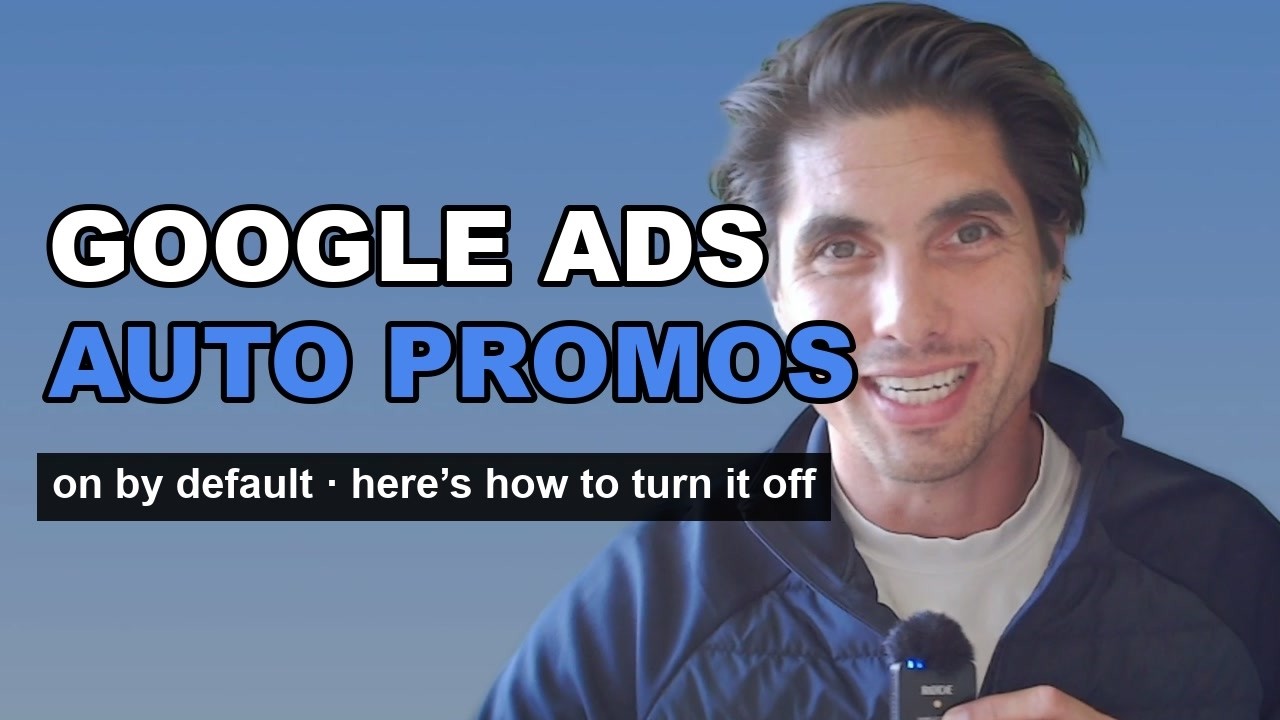
Since 12 October, Google Ads can put a discount in your ads that you never approved. The feature is called automated promotions: Google reads the coupons and deals on your website and attaches them as promotion assets to your Search and Performance Max campaigns. It's switched on by default. If you don't want it, you have to go into the account and turn it off yourself.
Google announced the change to advertisers by email in early October, and both Search Engine Roundtable and PPC Land picked up the details. I recorded a short video on what it does, who it hits and where I think it's heading:
What Google actually switched on
Google's own help page describes automated promotions as an AI-powered feature that "automatically sources, validates, and displays high-quality deals and offers from your website and other sources". Those promotions are then served inside Search and Performance Max campaigns that use location assets.
The scope is narrower than the headlines suggest, and that matters. It only applies to campaigns with linked location assets that don't already carry promotion assets. Location assets attach a business address from a linked profile to your ads on Search and Maps, and as PPC Land points out, they don't require a verified profile. So this is mostly a local-business feature: the shop with a storefront, the clinic, the garden centre running Performance Max with its address attached. In other words, exactly the kind of account where nobody opens the asset report every week.
The good version of this
I want to be fair, because there is a real upside. If your website is in order, you maintain your offers in one place. Put a promotion live on the site and Google picks it up for the ads. Take it down, and it disappears from the ads too. No second login, no forgetting to pause the promotion asset after the sale.
That only works if the offer is readable by a machine. Written out as text on the page, not just baked into a banner image. Ideally with structured data behind it: Google's merchant listing documentation has fields for price, availability, shipping and even the date a price stops being valid. If your offers live there, cleanly, with a start and an end, this feature does what it promises.
The version I actually see
Here's my problem with it. Nearly every company I've worked with is terrible at taking promotions down. The Black Friday landing page stays live long after the offer ended. Nobody sets it to noindex. Twelve months later it gets revived, because it's Black Friday again and why build a new page when last year's is still sitting there.
Two weeks ago I wrote about an ended sale that was still showing on four shops while the cart charged full price, and promotion assets with no end date pointing at a 404. That was a mess people made by hand. Automated promotions takes the same leftovers and gives them a route into your ads without anyone in the account clicking "create". A forgotten coupon page becomes ad copy. A customer clicks expecting a price you no longer honour, and the first contact with your brand is a broken promise. If you've read my post on price governance, you know promotions rarely end cleanly on their own.
"Every ecosystem has a default culture. (...) Don't just blindly adopt it." Ben Horowitz, What You Do Is Who You Are
Horowitz wrote that about company culture. It applies just as well to an ad platform's defaults. A default is a decision somebody else made, for their own reasons.
How to turn it off
It's an account-level switch, not a campaign setting. Google documents the route under account-level automated assets:
In Google Ads, open the Campaigns menu and select Assets. On the Associations tab, click the three-dot menu at the right of the asset table and choose Account level automated assets. Click the three-dot menu again and select Advanced settings. Find Automated promotions, set it to Off, choose a reason and save.
Two checks while you're in there. First, filter your assets by the promotion type. According to Relevant Audience's walkthrough, the automated ones are labelled "Google AI" in the Added by column, so you can see whether anything has already been pulled in. Second, if you do want promotions in your ads, there's a middle route: campaigns that already carry your own promotion assets are excluded, and manual promotions take precedence over sourced ones. Just give them an end date, which Google's promotion asset settings let you do.
Where this is going: your website becomes the brief
The toggle isn't the real story. The direction is. For years the ad account was where you told Google what to say: these are the ads, these are the promotions, these are the dates. This feature flips that. The website becomes the source, and Google builds the ad from what it finds there.
Follow that line and you end up with a system where your site holds everything in structured form: the promotion running now, the prices, the timeline, the product details, where you ship to. Google builds its own campaigns around it. And it won't only be Google. AI shopping agents will pick from the sites whose structured data fits the way they shop, which is the same shift I described when I argued that Amazon should let Muse in. This feature is a small peek at what's coming over the next months and years.
Which means the boring work becomes the important work. Someone has to own what's live on the site, with end dates that actually end and data a machine can trust. That's not a tool problem. It's an ownership problem, and no setting in the ad account solves it for you.
Do I like it?
Honestly, I don't know yet. It depends on how it affects campaign performance and how well Google communicates the coupons it finds. For a business with a disciplined website, it could save real time. For almost every business I've worked with, the risk is bigger than the convenience until the old promo pages are cleaned up. Check the setting, clean the site, then decide.
Your website was always public. Now it's also your ad copy.
Sources & further reading
External
Google Ads Help: About account-level automated assets
Google Ads Help: About promotion assets
Search Engine Roundtable: Google Ads automated promotions start October 12
PPC Land: Google Ads will auto-apply website coupons to some campaigns from October 12
Relevant Audience: Google Ads will switch on automated promotions by default on 12 October
Google Search Central: Merchant listing (Product, Offer) structured data
Ben Horowitz, What You Do Is Who You Are (Harper Business, 2019)
Related posts
An expired promotion doesn't expire by itself
Price governance in ecommerce: how a promotion died silently on four country shops for a month
Amazon should let Muse in. Blocking AI shoppers is the bigger risk.